









Risk, Technology, and Trust—Is Your Organization Built to Withstand What’s Next?
19 March 2026
Written by: Jeffrey R. Ritchie, CPAIn today’s rapidly evolving business environment, risk is no longer confined to internal operations, it extends across your technology, your vendors, and even the tools you use to drive innovation.
From artificial intelligence to third-party service providers, organizations are moving faster than ever to stay competitive. But what moves you forward can also expose you to new vulnerabilities. Given these new risks, is your organization is prepared to manage them?
The Expanding Risk Landscape
Organizations today operate in a highly interconnected ecosystem. With increased reliance on vendors, cloud platforms, and digital tools, risk exposure has grown significantly. A single cyber incident, whether internal or through a third party, can:
- Disrupt operations
- Result in financial loss and regulatory fines
- Damage your reputation and customer trust
It’s important to remember that just because you outsourced a function, it does not mean that you have outsourced your responsibility over that function, or the impact to your organization if something goes wrong.
When a Vendor is Breached Are You Prepared?
Many organizations don’t fully evaluate the risks tied to their vendors until it’s too late. Strong third-party risk management starts with asking the right questions:
- What sensitive data do vendors have access to?
- How is that data stored and protected?
- Are vendors independently validated through third-party assessments?
- Do vendors rely on additional third parties and how are those risks managed?
Without clear visibility into these areas, organizations expose themselves and their customers to unnecessary risk.
Where SOC Reports Fit In
System and Organization Controls (SOC) reports are one of the most effective tools for building trust and transparency in today’s environment. They provide independent validation that an organization has designed and implemented controls to manage risk effectively, particularly around financial reporting and data security.
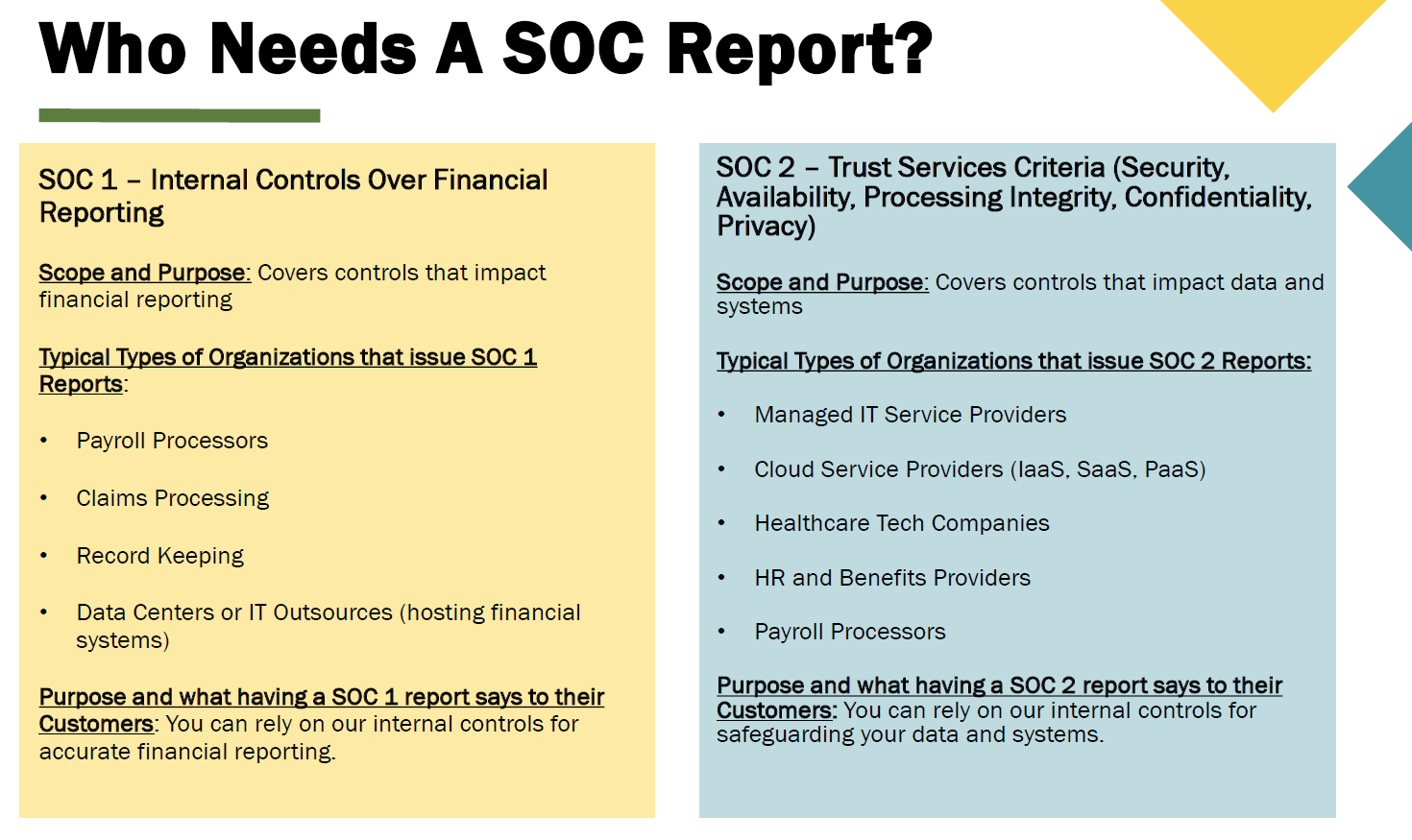
The most common SOC reports are SOC 1s and SOC 2s:
- SOC 1 (Financial Reporting Focused): Used by organizations whose services impact their clients’ financial reporting.
- SOC 2 (Data and Security Focused): Used by organizations responsible for managing or processing customer data, with a focus on security, availability, confidentiality, processing integrity, and privacy.
For organizations relying on vendors and third parties, reviewing and understanding SOC reports is a critical step in evaluating how your data is being protected and whether your partners have strong internal controls.
The Rise of AI: Opportunity Meets Risk
While third-party risk continues to grow, another major disruptor is reshaping the landscape: Artificial Intelligence.
AI is helping organizations:
- Improve efficiency
- Reduce costs
- Enhance decision-making
- Deliver better customer experiences
But it also introduces new and often misunderstood risks.
Key AI Risks to Consider
- Data Privacy & Security: Sensitive data may be exposed if safeguards aren’t in place
- Inaccurate Outputs: AI-generated results may not always be reliable
- Bias: Models may produce unintended or unfair outcomes
- Lack of Transparency: Many AI systems operate as “black boxes”
Failing to address these risks can lead to operational, financial, and regulatory consequences.
Why Governance and Controls Matter More Than Ever
Whether it’s AI, vendors, third-parties, or internal systems, one theme remains consistent: Strong governance and internal controls are the foundation of effective risk management.
Organizations should:
- Understand where and how technology is being used
- Establish formal governance structures
- Implement policies, procedures, and oversight
- Continuously monitor and assess risk
This includes developing clear frameworks around emerging technologies like AI, as well as maintaining strong oversight of third-party relationships.
Turning Risk into a Strategic Advantage
Organizations that take a proactive approach to risk aren’t just protecting themselves, they are gaining efficiencies, improving their resiliency, lowering costs, and building trust with their customers and stakeholders.
At FustCharles, our Risk & IT Assurance team helps organizations do exactly that.
We provide:
- SOC 1, SOC 2, and SOC 3 reporting
- IT control assessments
- Third-party risk management support
- AI governance and internal control evaluation
- Enterprise risk management assessments
- Process improvement
- Internal control transformation services
Our approach is tailored, practical, and designed to support both compliance and growth.
Is Your Business Built to Withstand the Risk?
As technology continues to evolve, so will the risks that come with it.
The organizations that succeed will be the ones that:
- Understand their risk landscape
- Implement strong internal controls
- Understand and manage their vendor and third-party relationships
- Govern emerging technologies effectively
Because in today’s environment, resilience isn’t optional, it’s essential.
Let’s Talk About Your Risk Strategy
Whether you’re navigating third-party risk, AI adoption, or evaluating internal controls, our team is here to help.
Contact Jeff today to discuss your organization’s needs.
Meet Our Expert
Jeffrey R. Ritchie, CPA - Principal | jritchie@fustcharles.com

Jeff Ritchie is a risk and controls specialist with over 13 years of experience helping both public and private organizations assess and manage their risk landscapes. Jeff’s expertise across both operational and IT control environments allows him to provide a unique perspective and insight to clients, which is tailored to their specific risks. This allows organizations to make better decisions and provides a comprehensive and streamlined way to identify and manage their risks.
Jeff has extensive experience in System and Organization Controls reporting (SOC 1 and SOC 2), enterprise risk management, internal control transformation projects, SOX 404 compliance, IT control assessments, process improvement and control readiness assessments.
Jeff is a CPA licensed in New York and is a member of the American Institute of Certified Public Accountants (AICPA) and the New York State Society of Certified Public Accountants (NYSSCPA). He obtained his B.S. and M.S. in Accounting from Siena College and resides in Syracuse.
Back to News